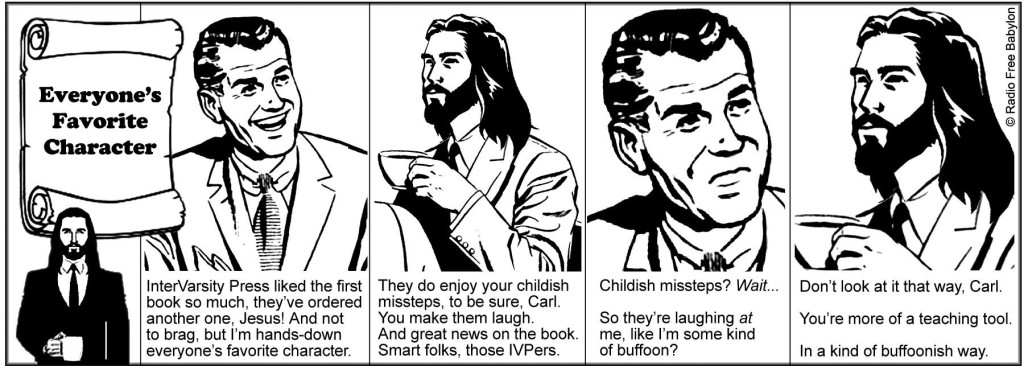
If you’ve been apart of Christian culture for long enough you’ve probably suffered the indignity of a ‘christian comic strip’; heavy-handed, ham-fisted, and most of all not funny. Dave Wilkie the creator of Coffee With Jesus is here to help. The comic manages to juggle cultural critique, poignancy, and oh yeah, it’s super funny.
…how CwJ started as just a one-off cartoon and what made Dave want to make antibiotics that first strip
…what made Dave decide to do more after that one-off strip
…Dave’s background in illustration
…the thought process in deciding to give the characters a backstory
…why the characters got backstories
…the responsibility in having Jesus say things in the strip
Sponsorship
Seminary Dropout has ended it’s run with it’s previous sponsor and is now available for new sponsors. If you’re interested in advertising your non-profit, conference, or other endeavor send me an email at shane[at]shaneblackshear.com
If you liked this episode then you might also like…
Calling all Baby-Boomers, Gen X’ers, and Mellenials who grew up in the Christian bubble. It’s time take a little walk down memory lane.
4. Davey & Goliath
This was way before my time. This was way before most of our times. The first D&G episode was created in 1960. Produced and financed by the United Lutheran Church in America, D&G became a cultural force. Three million people watched D&G at it’s height.
D&G episodes dealt with important life lessons and even helped explain theology in a way that was relatable to children. The show holds up surprisingly well even for being off the air since 1975. The show also featured black characters, which is something that even shows today often fail to do.
The production value was as good as it got in its time, and even now looking back, the claymation is truly beautiful.
3. Gerbert
I’m pretty sure Gerbert played on The Family Channel on Sunday mornings as the Blackshear family was getting ready for church. Gerbert was the product a guy named Andy Holmes who used the puppet to entertain kids in the hospital in Abilene, TX.
Gerbert the show had relatively high production value, especially for its time. The show couldn’t help itself and often included musical interludes lead by actors that most likely were church members who had nothing better to do after church one Sunday but put on an ill-fitting costume and memorize a few lines. Nevertheless Gerbert communicated concepts of Christian morality without being too preachy and with relatively little camp.
2. McGee and Me
Back in the late 80’s and early 90’s a Christian bookstore was magical alternative world. They had T-shirts like any store at the mall but these took the logos of the mall T-shirts and christianized them. Golds Gym became Lords Gym (It took me a really long time to understand what that shirt was parodying and who can blame me, it doesn’t even rhyme), Coca-Cola became Jesus Christ (in Coca-Cola font), and so on and so forth. There was music too, music of every genre that the secular music store had, and many times with very similar cover art, but this was ‘christian’ music.
Then there was the VHS section. It was probably 1/20th the size of a video stores selection, and let me tell you, it got weird. Budgets were low, writing was bad, and puppets abounded. It’s amazing that amongst the riffraff we all stumbled into McGee and Me.
I dare say that McGee and Me could stand toe to toe with any childrens television programing of its time. It was well written, mostly well acted, and the opening credits featured a Goldberg machine that was (ostensibly) created by the main character who was wicked smart and an amazing artist. I was neither of those things but I liked the idea of being those things so suffice it to say that 7-year-old me was definitely on board.
M&M featured animation on top of live acting which in retrospect was probably a respectable technological feat in 1989.
1. VeggieTales
How did this get made? I mean seriously. How did it get funded? How did someone have the vision to bring christian programing not only up to date, but in many ways lead the way for secular programming?! Veggie Tales debuted in 1993. That’s right 1993! Remember Toy Story was released in 1995! Computer animation was still in its infancy at this time. VT must have cost a fortune back then and had some very intelligent, and visionary people behind it (which reminds me, Phil Vischer, please come on Seminary Dropout).
I think VT was the first christian programing that’s almost as fun to watch as an adult as it is for a child. Pop culture references and clever puns abound. You’re kid won’t catch them, but you will.
VT was so good that secular programming wanted them. VT was on NBC at one point with the overtly religious content edited out, and now a reiteration of Veggie Tales (Veggie Tales in the House), runs on Netflix.
Before Bob & Larry plush toys became ubiquitous and VT took over your dvd collection, VT was a clever and fun show with the highest production quality around.
On Pete’s website it says that he is a “provocative writer, philosopher, storyteller and public speaker” , and it’s true he is provocative, in fact his words can make some of us in the church squirm a bit, but you don’t have to agree with Pete to find his thoughts and ideas insightful.
Rollins new book ‘The Divine Magician’ is about reimagining the message of Christianity. Using the illustration of the steps involved in a magic trick; the pledge, the turn, and the prestige, Rollins proposes that the Eucharist might include some of the same elements.
Some things we discuss on this episode:
How Pete’s upbringing has affected the type of theology & philosophy he’s come to practice today.
The evolution of Pete’s work over the years, from his earlier work that seemed to be more transformative art that was focused on experience (IKON collective to parables) to his more recent work in “The Idolatry of God” and “the Divine Magician” being very theological and constructive.
The Pyro-theology Pete practices that shifts focus from a set of beliefs to the way in which we engage the world, is it mutually exclusive from the Christianity that would include mysticism and supernatural aspects.
The use of the three parts of a magic trick – the Pledge, the Turn, and the Prestige as illustrations for Christianity.
In this season of lent, what’s the point of focusing on the death of Christ? What are good lenten practices for those who want to recognize the “other” inside themselves?
This notable quote “Christianity should not be thought of as the means of bridging a gap. This event is nothing less than the smashing of the whole chasm / bridge idea that Gnostic spiritualities buy into. The liberation that this narrative expresses does not offer us the fullness we seek, but rather frees us from the need to seek fullness. “ -Peter Rollins
Remember our beloved sponsor for this episode is Deidox Films. If you like the podcast and want to support it then please check out Deidox and tell your pastor, worship leader or whoever organizes your worship gatherings about it. This week I recommend the short film James.
Deidox produces beautiful, high quality, short documentaries about the real lives of Christians.
Deidox Films is a 501(c)3 film production and distribution company. They are media missionaries. Their mission is to produce and promote documentary films that help the Church reflect Christ and redeem culture.
Their purpose is to partner with Pastors and Church leaders to help make disciples and fulfill the Great Commission. They do this by creating visual models of faith that provide practical examples of modern-day disciples.
If you liked this episode then you might also like…
A friend of mine recently expressed frustration on Facebook over the recent injustices towards people of color in our nation. One of the comments on the post was as striking as it was familiar. A white person expressed sympathy towards the plight of people of color in America today, expressed her own frustrations, and then concluded that we just have to ‘give it to God’.
Can I be so bold as to suggest that what we mean when we say ‘giving it to God’ might be the most backwards and unbiblical thing believers can do? To be sure ‘surrender’ and ‘submission’ to a holy God are undoubtedly biblical concepts, but those concepts only make sense when our will is in conflict with God’s. When we want true biblical justice, we don’t need to surrender our will to God because we know that our will is God’s will.
All too often what we mean when we say ‘give it to God’ is that we’re done trying, we’re throwing our hands up and hoping it all works out. It’s a very spiritual sounding way of saying -“I’m not going to do anything about this.”
Does this work in any area of life? If you lose your job, do you sit back and hope it all works out or do you get to work on a resume, and ask your friends and family if they have any leads? When your child is sick do you take a passive approach or do you get them to the doctor?
The entirety of scripture is the story of God inviting human beings to participate and partner in redemption and reconciliation with God.
My fear is that perhaps our real feelings are more sinister than simple exasperation, and are in reality an unwillingness to follow God into true participation of a radical reconciliation process.
As a white person, partnering with God probably means being intolerant of my church being 99% white and having no positions of leadership belonging to people of color. Partnering with God might truly mean moving out of my 95% white neighborhood and sending my kids to a school that isn’t 95% white.
Partnering with God means intentionally, purposefully and regularly praying against violence, against the idea that black men are to be feared and presumed guilty, and that poverty within minority communities is simply a choice they have made, and examining ourselves to eradicate any of those feelings within ourselves.
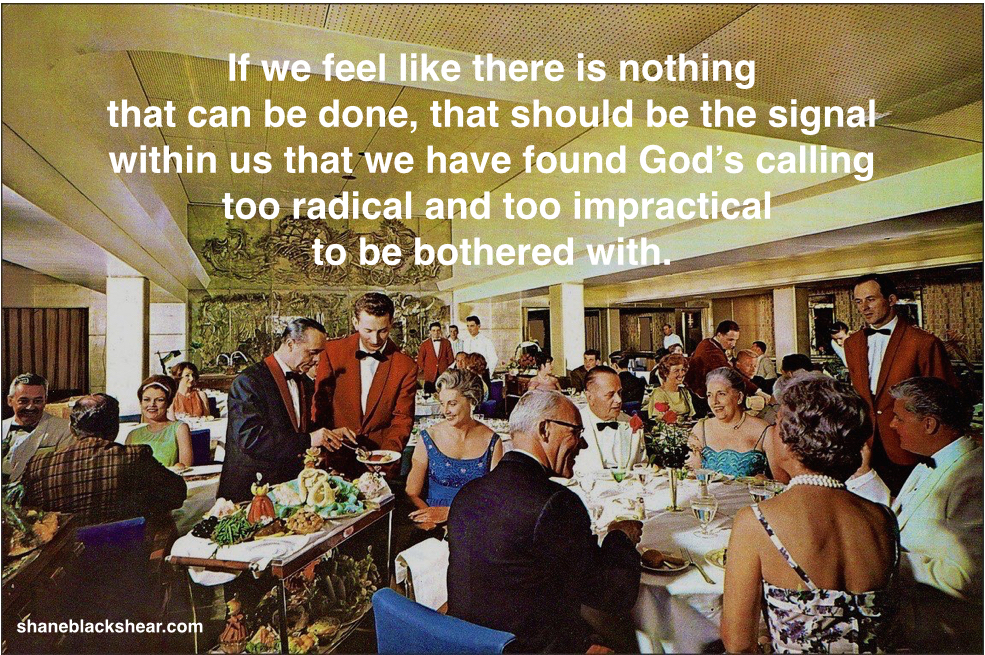
We can’t act as if God hasn’t given us a means of being co-laborers with Him, that’s not His nature, He has promised to prepare good works for us in advance (Eph 2:10). If we feel like there is nothing that can be done, that should be the signal within us that we have found God’s calling too radical and too impractical to be bothered with.
Like I said, I’m extremely excited to be apart of this conference and to be included in such a stellar line up. If you’re in the Portland area (and even if you’re not) I’d LOVE to see you there.
Almost immediately after the conference we’ll be doing something big. Like really BIG.
*drum roll begins*
Like, the first ever, live taping of Seminary Dropout.
Here is your chance to be present at the first ever live taping of the podcast. Just like the non-live version, I’ll have an amazing guest (yet to be announced) and we’ll talk about faith and life.
There should be enough seating for everyone but just in case you’d better register here.
Several months back I reread C.S. Lewis’s Mere Christianity. I was struck at how many things he said with a tone of being new or controversial, while in todays Christian worldview they were commonplace. I can only assume that in that important work of Christian literature he established a new normal within Christianity, and for the most part I’m thankful for that. I love Lewis, he’s brilliant, he loved the Lord. I also think he was wrong about some things. For all the ways that he ignored culture and had a vision for the world as God saw it, in many ways he was also a product of his time.
While I think Lewis would shutter to know how readily many Christians rush to support war and violence today. He was far from a pacifist, and he left no doubt with this passage…
…the Christian in arms for the defense of a good cause – is one of the great Christian ideas. War is a dreadful thing, and I can respect an honest pacifist, though I think he is entirely mistaken.
I say all of this because I want to borrow (steal?) Lewis’s rhetoric and turn it on it’s head, because it’s the exact (opposite) way I feel about the issue.
I can respect the honest violence-apologist, but only after they’ve ready closely the words of Jesus and how Christians have interpreted those words throughout history, especially before Constantine ushered in the idea of Christian military power.
More to the point if you’ve honestly read the Sermon on the Mount with a fresh ear, and read Christian literature on non-violence and still don’t see Jesus’s call in scripture to it, then although I still disagree with you, you’ve certainly earned the right to believe that God allows violence. But more than not, those I hear beating the war drum in the name of Christ have no theology behind it other than some vague notion about violence in the Old Testament, and a feeling that ‘God is on our side’. It seems like when something as serious and sacred as a human life is on the line, we had better do our homework and make sure that what we believe is based on something substantial.
We hear of a new terrorist attack in the news seemingly every week. Isis, Al-Qaeda, mass killings, beheadings; it’s enough to make us scared.
I remember when the Sandy Hook school shootings happened and parents across the country were struggling to find ways to tell their kids that it was safe for them to go to school. The problem was that children don’t have a good grasp on the vast remoteness of something similar happening to them; the idea that yes, something horrible happened but, there are over a hundred thousand primary schools in the country and all but a minute number of them have had a very peaceful existence, is lost on a 6-year-old who’s scared.
By now maybe you’ve gathered where I’m going with this.
Many adults, Christian adults, also have a problem conceptualizing that the frequent reporting of Muslim terrorist attacks in the news in no way portrays a picture of the minutia of Muslim terrorists in a sea of 1.57 billion Muslims world-wide.
So to be clear, to portray Islam as a religion of hate/war/death/etc., based on those Muslims involved in terrorists attacks is first, factually inaccurate, and facts should matter for Christians, we’re called to be truth tellers and seekers. We tend to act like there’s no one who calls themselves a Christian who embarrasses us. How would you feel if you were lumped in with Woodsboro Baptist Church as they protest funerals of members of the military, or the actions of Christians in the Crusades where the death toll is somewhere between 1 and 3 million?
Second, and maybe more importantly, it’s no way to show love to Muslims in our community. I say ‘more importantly’ because it wouldn’t really matter if 100% of Muslims were terrorists or extremists, our call to from the mouth of Jesus himself to love our enemies does not change, and although many have tried, it takes an enormous suspension of disbelief to conclude that literal violence or even speaking hatefully is loving.
Don’t misunderstand me! This is not an ‘all religions lead to the same God’ post. I find it intellectually impossible to follow the Jesus of scriptures and also believe in that type of Unitarianism. In fact it’s this belief in the exclusivity of Jesus as Lord and Savior that compels me to share his radical love and not disparaging generalizations with everyone.
Suppose one reads a story of filthy atrocities in the paper. Then suppose that something turns up suggesting that the story might not be quite true, or not quite so bad as it was made out. Is one’s first feeling, ‘Thank God, even they aren’t quite so bad as that,’ or is it a feeling of disappointment, and even a determination to cling to the first story for the sheer pleasure of thinking your enemies are as bad as possible? If it is the second then it is, I am afraid, the first step in a process which, if followed to the end, will make us into devils. You see, one is beginning to wish that black was a little blacker. If we give that wish its head, later on we shall wish to see grey as black, and then to see white itself as black. Finally we shall insist on seeing everything — God and our friends and ourselves included — as bad, and not be able to stop doing it: we shall be fixed for ever in a universe of pure hatred. -C.S. Lewis

 If you’ve been apart of Christian culture for long enough you’ve probably suffered the indignity of a ‘christian comic strip’; heavy-handed, ham-fisted, and most of all not funny. Dave Wilkie the creator of Coffee With Jesus is here to help. The comic manages to juggle cultural critique, poignancy, and oh yeah, it’s super funny.